


Artificial Intelligence for Business from WOP lab
Contents
- AI-Based Solutions in WOP lab
- Integration of Generative Models and LLM Agents
- Automating Customer Experience via Conversational AI
- WOP lab: Optimizing Operational Processes with Neural Networks
- Predictive Analytics and Demand Forecasting
- Intelligent Document Processing (IDP)
- Technology Stack and Security from WOP lab
- Corporate Data Protection and Confidentiality
- FAQ
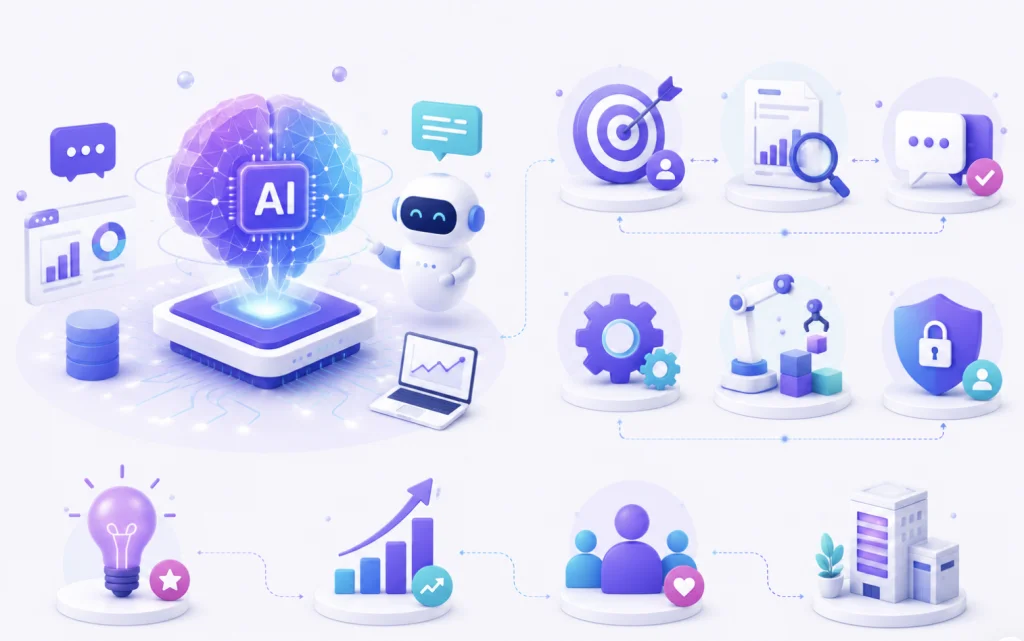
Integrating advanced technologies into the corporate environment has shifted from a competitive advantage to a fundamental requirement for maintaining market positions. Artificial intelligence for business facilitates a transition from reactive management to a proactive strategy based on deep data analysis and the automation of cognitive tasks. Professional implementation of neural network architectures allows companies to scale processes without a proportional increase in headcount or operational expenditures.
AI-Based Solutions in WOP lab
Developing intelligent systems requires a comprehensive approach that combines an understanding of business objectives with profound technical expertise. AI-based solutions from WOP lab experts include the design of custom architectures tailored to the specific needs of a particular industry.
Integration of Generative Models and LLM Agents
Utilizing generative AI and autonomous LLM agents enables the automation of complex content creation, software code generation, and expert-level customer support. Fine-tuning technology ensures that the neural network operates exclusively on up-to-date corporate data, adhering to brand voice and quality standards.
Automating Customer Experience via Conversational AI
The implementation of Conversational AI transforms sales and support departments into high-efficiency conversion centers. Modern AI assistants are capable of processing thousands of simultaneous inquiries, providing instantaneous responses and a personalized approach to every user. This directly impacts audience loyalty and reduces the burden on human resources.
WOP lab: Optimizing Operational Processes with Neural Networks
A systematic approach to digitalization involves auditing current processes and identifying bottlenecks where automation will yield the maximum return on investment. Applying machine learning algorithms to operational activities minimizes errors caused by the human factor.
The following comparative table illustrates the efficiency of business processes before and after the implementation of specialized automation tools:
| Efficiency Parameter | Traditional Approach | With AI-Based Solutions |
| Data Processing Speed | Hours or working days | Seconds (Real-time) |
| Demand Forecasting Accuracy | 60–75% | 95% and higher |
| Customer Support Availability | Strictly during business hours | 24/7/365 without delays |
| Scaling Costs | Linear growth of expenses | Minimal infrastructure costs |
The data presented confirms that transitioning to automated frameworks ensures a significant increase in productivity while simultaneously reducing variable costs.
Predictive Analytics and Demand Forecasting
Predictive analytics allows companies to forecast consumer behavior and market trends with high precision. This ensures the optimization of inventory levels, marketing budget planning, and the prevention of customer churn. Algorithms analyze historical data in combination with external factors to form a reliable basis for management decision-making.
Intelligent Document Processing (IDP)
IDP (Intelligent Document Processing) technology automates data extraction from invoices, contracts, and other documentation. This eliminates routine data entry and accelerates document workflows ten-fold, allowing employees to focus on strategic tasks.
Technology Stack and Security from WOP lab
Corporate data security is a priority when deploying AI infrastructure. The use of closed environments and specialized vector databases guarantees that confidential information never enters the open training sets of public models.
Corporate Data Protection and Confidentiality
Applying modern encryption protocols and API integrations with controlled access ensures seamless and secure system operation. Expertise in Prompt Engineering allows for the configuration of models to provide highly relevant outputs while strictly adhering to established security protocols and preventing the leakage of intellectual property.
FAQ
How quickly do AI-based solutions pay off?
The average return on investment (ROI) for high-quality AI solutions ranges from 6 to 12 months. Primary savings are achieved through routine automation, the prevention of costly errors, and increased sales conversions.
Is it possible to integrate AI into a company’s existing IT infrastructure?
Yes, modern AI solutions are designed as modular systems. Through API integrations, neural networks connect to existing CRM, ERP, and CMS systems without requiring a complete overhaul of the current IT architecture.
How is corporate information security ensured when working with LLMs?
Security is guaranteed through the use of isolated cloud or local servers. Corporate data is stored in protected vector databases, and access to models is strictly regulated, which completely mitigates the risks of unauthorized access.
To conduct a technological readiness audit and develop a customized AI implementation strategy, requesting an expert project evaluation from WOP lab specialists is recommended.


