


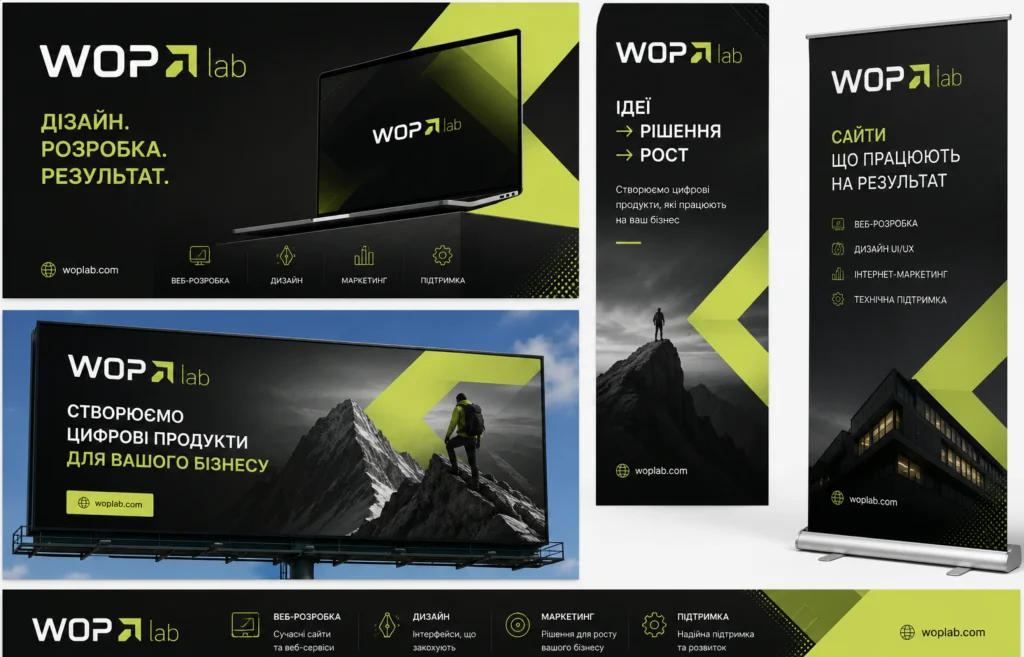
Banner Design and Manufacturing at WOP lab
Contents
Effective visual communication requires a professional approach to selecting advertising media. Banners remain one of the most sought-after tools for outdoor and indoor advertising due to their scalability, durability, and high production speed.
Advertising Banners at WOP lab: Types and Applications
The choice of printing substrate determines the durability and aesthetic appeal of the advertising structure under various operating conditions. Properly selected material guarantees the preservation of color brightness and fabric integrity throughout the entire period of use.
The table below presents the main characteristics of materials used for the production of advertising media:
| Material Type | Service Life | Optimal Application | Advantages |
| Cast Banner | 12+ months | Billboards, building facades | Increased strength, frost resistance |
| Laminated Banner | up to 3 months | Interiors, short-term promos | Cost-effective, lightweight |
| Banner Mesh | up to 24 months | Building wraps, giant posters | Low windage, light transmission |
| Blockout | up to 24 months | Double-sided printing, banners | Complete opacity |
This classification allows for the precise selection of material based on specific marketing objectives and climatic requirements, optimizing the promotion budget.
Cast and Laminated Fabrics
Order banners on a cast base for long-term outdoor placement. Casting technology provides the material with elasticity and resistance to tearing under heavy wind loads. Laminated options are optimized for short-term promotional campaigns and interior use, ensuring minimal investment while maintaining high-quality color reproduction.
Specialized Solutions for Facades
Banner mesh (Mesh) is used for decorating large-scale objects. The perforated structure of the material minimizes wind load, preventing damage to the mounting structures and the building itself. When double-sided advertising media are required, Blockout fabric is utilized, featuring a special internal black layer that eliminates image ghosting.
Banner Manufacturing at WOP lab: Technical Standards
Compliance with strict production regulations guarantees a high-quality finished product that fully matches the original digital layout. Banner printing performed on modern equipment features sharp lines and resistance to ultraviolet radiation.
The technical preparation process includes the following mandatory stages:
- Layout development in the CMYK color model for precise color matching.
- Setting the print resolution from 72 to 1440 DPI depending on the viewing distance.
- Utilizing vector graphics to maintain the clarity of logos and fonts.
- Reinforcing the perimeter of the fabric by hemming or welding the edges.
- Installing metal eyelets for secure fixation of the structure.
A comprehensive approach to preparation and post-print processing eliminates manufacturing defects and significantly extends the service life of the media in aggressive external environments.
WOP lab: Banners as a Conversion Tool
In modern market conditions, banner prices that include professional UI/UX strategy development demonstrate a significantly higher return on investment. The specialists at WOP lab focus on creating a hierarchy of visual accents, making the advertising message readable from a long distance. An emphasis on contrast, concise text, and a clear call to action (CTA) transforms a standard fabric into an effective customer acquisition channel. Professional banner manufacturing avoids typical mistakes such as poor readability or distortion of corporate colors.
Frequently Asked Questions
What is the difference between a cast and a laminated banner?
A cast banner is manufactured by dipping the mesh into liquid PVC, making it a single, extremely strong unit. A laminated banner is created by gluing two layers of PVC together, which reduces the cost but makes the material more sensitive to creases and low temperatures.
What are the artwork requirements for large-format printing?
Layouts must be created at a 1:1 scale, use the CMYK color model, and contain no small fonts below 6–8 points. All fonts must be converted to curves, and raster images must have a resolution appropriate for the format and placement of the product.
How to calculate the optimal number of eyelets?
The standard spacing for eyelets is 30 cm around the entire perimeter. For structures subject to extreme wind loads or oversized banners, it is recommended to reduce the spacing to 20 cm and use additional edge reinforcement with webbing.
To evaluate project complexity and receive expert recommendations on material selection, please contact WOP lab specialists.


