


Brandbook and Guideline Development for Business
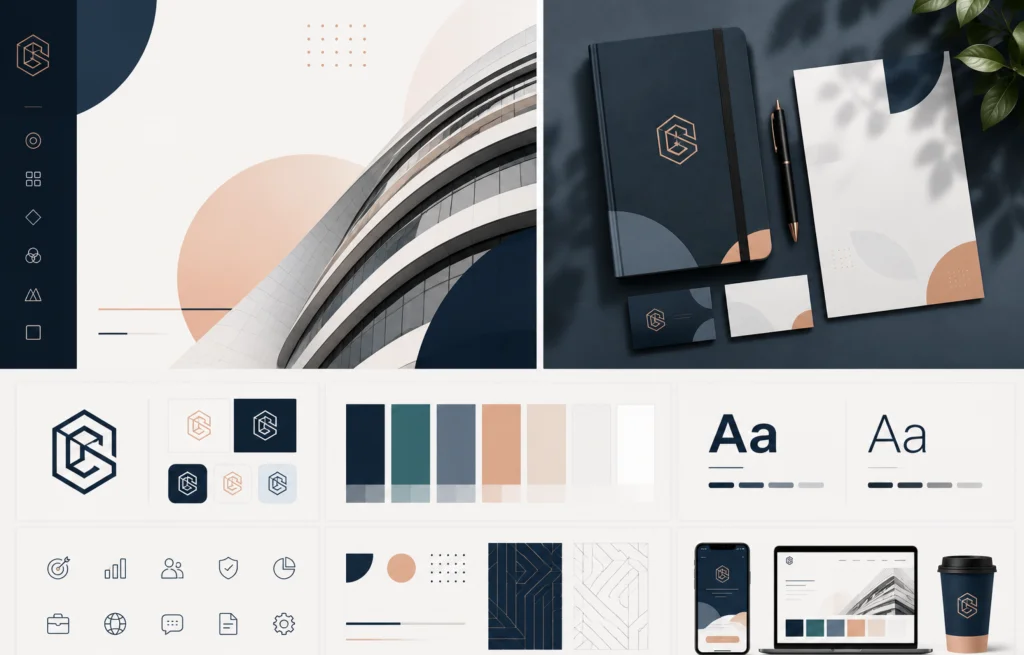
Contents
A systematic approach to visual communications serves as the foundation for modern business capitalization. In a highly competitive market, brandbook creation is more than an aesthetic choice; it is a strategic tool ensuring brand consistency across all consumer touchpoints. Professional brandbook development eliminates marketing material chaos and establishes a basis for long-term company scaling.
Brandbook: WOP lab
A fundamental brandbook provides a comprehensive description of a company’s philosophy and ideology. This document defines how the brand is perceived by the audience on emotional and rational levels. Deep analytical processing of meanings at the start ensures a stable foundation that remains relevant for 5–10 years, removing the need for regular rebranding.
Ideological Platform and Strategy
The design process begins with the formation of the brand mission, its core values, and positioning. Defining the Tone of Voice (communication tonality) ensures that interaction with the client remains consistent across all channels — from social media to official documentation. This approach transforms visual style into a powerful sales tool that broadcasts reliability and professionalism.
Visual Identification Standards
Visual identity occupies a central place in the structure. It includes the detailed development of a logobook, definition of the color palette (CMYK, RGB, HEX codes), and selection of corporate typography. Strict regulation of font pairs and heading hierarchies ensures instant brand recognition even in the absence of a direct mention of the company name.
Guideline in WOP lab
While a brandbook focuses on strategy, a guideline is a purely technical manual for visual style implementation. Detailed instructions minimize the risk of errors when working with external contractors, printers, and advertising agencies, significantly saving marketing budgets in the long run.
The following table provides a comparison of the primary documentation types to clarify their specific roles:
| Characteristic | Logobook | Guideline | Brandbook |
| Primary Focus | Logo usage rules | Technical style implementation | Strategy and ideology |
| Target Audience | Designers, printers | Marketers, web developers | Top management, partners |
| Key Benefit | Correct symbol display | Consistency across all media | Brand capitalization and value |
This classification allows for precise determination of the required work scope based on current business objectives and the stage of project development.
Technical Regulations for Element Usage
This section includes rules for construction of clear zones, minimum allowable logo sizes, and prohibited usage variants. Special attention is paid to the modular grid, which serves as the basis for the layout of any advertising materials, guaranteeing visual balance and a professional product appearance.
Adaptation for Digital and Physical Media
A modern guideline must account for the specifics of various environments. This includes the preparation of vector source files for printing and optimized formats for the Web. Designing standards for Outdoor Advertising and a Social Media Kit allows the brand to look cohesive both on a massive billboard and a smartphone screen.
Brandbook Creation from WOP lab
The development process at WOP lab, a technology company, combines design aesthetics with IT solution functionality. This ensures that the created brand identity is not only attractive but also technically flawless when integrated into complex digital products.
Design Stages: From Brief to Rights Transfer
Work is built on the sequential execution of stages: from completing a detailed brief and conducting a brand audit to creating moodboards and final concept visualizations. Each iteration is accompanied by a deep analysis of the competitive environment, allowing the company to stand out in the market. The result is a full copyright transfer of intellectual property to the client.
UI Kit and Web Standards Formation
For companies focused on digital presence, the availability of a UI Kit is critical. The list of key elements included in the digital style extension is presented below:
- Styling for buttons and interactive elements;
- A set of system and decorative icons;
- Rules for designing feedback forms;
- Grids for responsive interface versions.
Implementing these standards during the guideline development stage reduces interface design time and simplifies future web resource maintenance.
FAQ
What is the fundamental difference between a brandbook and a guideline?
A brandbook describes the philosophy, mission, and strategy of the brand (the “soul” of the company), while a guideline contains technical instructions for applying visual elements (the “instruction manual”).
How does having a brandbook affect marketing communication costs?
The existence of standards reduces the time required to prepare any advertising materials by 30–50%, eliminates costs for error correction and concept redevelopment, making brandbook investments highly profitable.
What file formats are delivered to the client upon project completion?
A full package of vector formats (.ai, .eps, .svg) for scalable graphics and high-resolution raster files (.png, .jpg) for day-to-day use in office tasks and the web are provided.
Contacting WOP lab experts for a professional consultation is recommended to receive a detailed audit of the current visual system or to develop a comprehensive brand creation solution.


