


Flutter Mobile App Development
Contents
The modern mobile software market demands high speed-to-market while maintaining flawless performance. Flutter app development has become the standard for businesses looking to reach iOS and Android audiences with minimal overhead. Utilizing this Google framework allows for the creation of interfaces that are identical to native solutions in smoothness and responsiveness, while ensuring significant resource savings.
WOP lab: Flutter Development
The technology stack is centered around the Dart object-oriented language, which provides strong typing and high code stability. This eliminates critical errors during operation and simplifies the scaling of complex systems. The technological foundation enables the implementation of projects of any complexity—from corporate services to high-load systems.
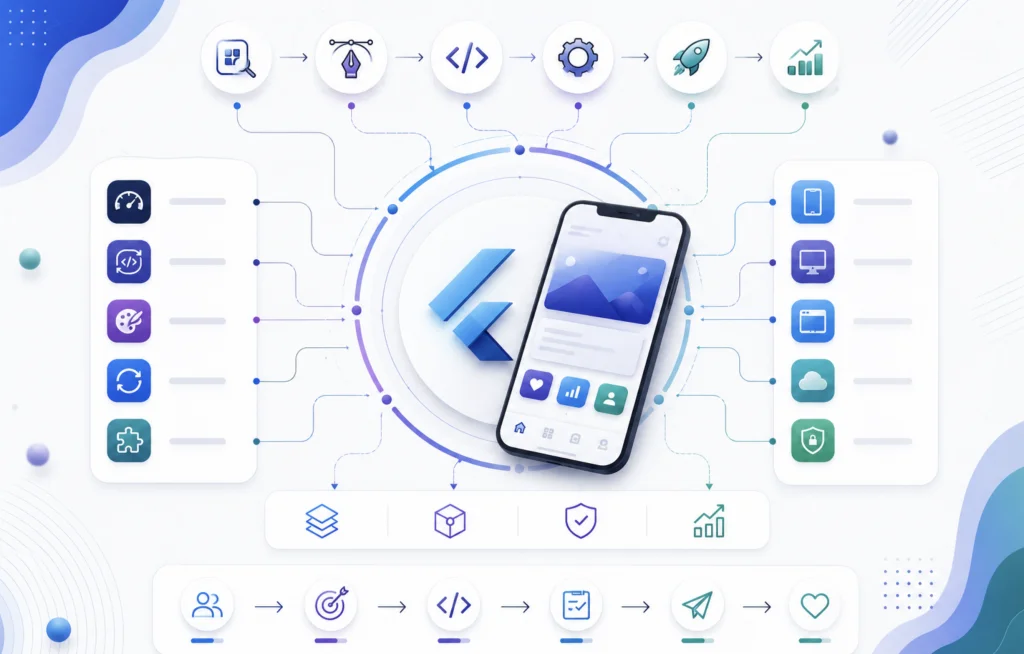
Key technological components ensuring product quality include:
- Impeller Graphics Engine: Guarantees stable 60–120 FPS and zero lag when rendering complex animations.
- AOT Compilation: Compiles code directly into machine instructions for near-instant app startup.
- Hot Reload: Accelerates the process of making changes and testing interfaces in real-time.
- State Management (BLoC/Riverpod): Ensures predictable app behavior when processing large datasets.
These tools allow WOP lab to build software with an architecture ready for AI integration and cloud services.
Flutter Advantages at WOP lab
The primary factor for choosing this technology is the single codebase. Instead of writing two separate apps for different operating systems, one project is created, reducing software maintenance and update costs by 40%. This strategic advantage allows companies to respond faster to market changes and user demands.
Comparative characteristics of the cross-platform approach versus native development are shown in the table below:
| Parameter | Native Development | Flutter at WOP lab |
| Time-to-Market (TTM) | High (2 teams) | Reduced by 40–50% |
| Development Cost | High | Optimized (1 team) |
| Performance | Benchmark | Identical to native (Impeller) |
| Code Maintenance | Complex (different stacks) | Simplified (single stack) |
Such resource allocation makes cross-platform app development the most cost-effective solution for modern business.
App Creation Process from WOP lab
The production process is built on principles of transparency and automation. During the design phase, an MVP (Minimum Viable Product) is created, allowing for business hypothesis testing in the shortest possible time. Special attention is paid to data security and the protection of the client’s intellectual property.
Project implementation stages include a strict sequence of actions:
- Business Analytics: Deep niche research and technical specification drafting.
- UI/UX Design: Creating adaptive interfaces using Material Design and Cupertino.
- Development and CI/CD: Continuous integration and automated code testing.
- Publishing: Full support through the App Store and Google Play moderation process.
The completion of each stage is accompanied by a technical audit, ensuring the product meets international quality standards.
FAQ
Is Flutter suitable for large-scale Fintech projects?
High security levels and the ability to use native modules via Method Channels make the technology ideal for banking and financial services. The BLoC architecture ensures reliable data state management even during peak loads.
What is the real budget saving when using Flutter?
Eliminating the need to hire two separate development teams (iOS and Android) reduces total production and long-term maintenance costs by up to 40%.
How does Flutter support OS-specific features like NFC or Bluetooth?
Integration with hardware features is achieved through specialized plugins and direct access to the native API, guaranteeing stable operation of sensors and external interfaces.
For a professional project evaluation, technical audit, or mobile solution implementation estimate, contact WOP lab experts for a professional consultation.


