


Testing, Validation, and Cleanup of Vibecode
Contents
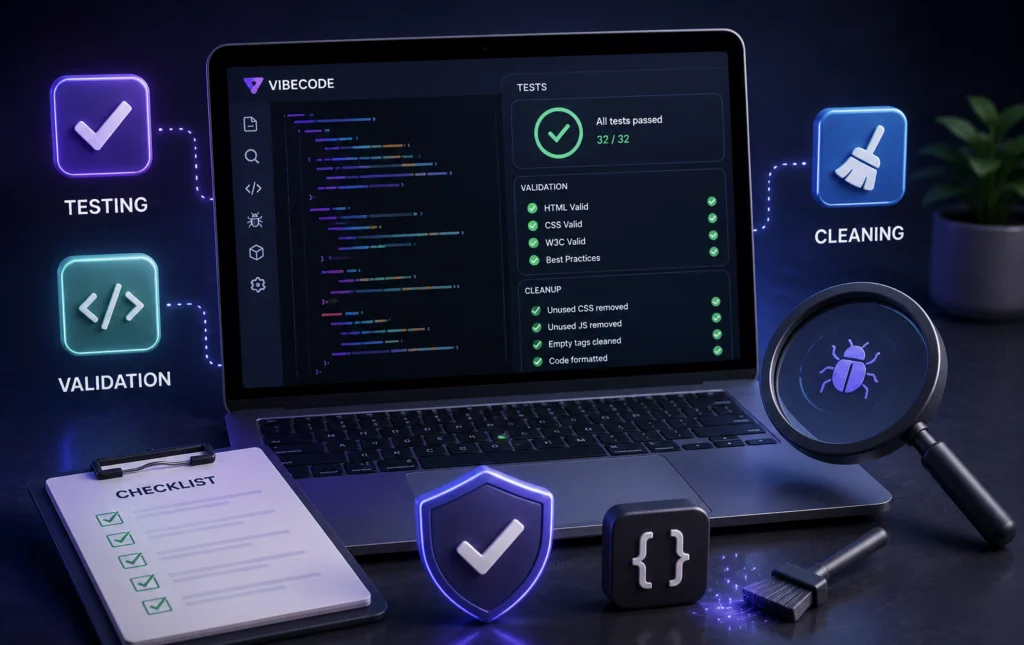
The use of Vibe Coding tools enables high-speed prototyping; however, transitioning to commercial exploitation requires professional software stabilization. Expert Vibecode validation directs the speed of AI generation into the channel of industrial reliability, eliminating risks associated with chaotic code structures.
WOP lab: Testing and Stabilization
The quality assurance process at WOP lab is based on multi-level functional verification. Automated control allows for the identification of hidden defects at early stages, transforming fast iterations into a stable technology stack.
A comprehensive approach to verification includes the following key areas:
- Unit Testing — verification of isolated logic components for operational correctness.
- End-to-End (E2E) Testing — simulation of complete user interaction scenarios with the interface and backend.
- Regression Testing — a guarantee that new changes do not disrupt the functionality of previously implemented features.
- Stress Testing — determining the system’s performance limits under peak loads.
The implementation of these methodologies ensures seamless application performance and minimizes the likelihood of failures in the user interface.
Architecture Validation in WOP lab
Vibecode validation involves a deep audit of logical connections and architectural compliance with industry standards. Professional analysis eliminates the redundancy that AI often introduces during generation, ensuring transparency and project manageability.
A comparison of code characteristics before and after expert validation is provided in the table below:
| Parameter | Original Generation (Vibe) | After WOP lab Validation |
| Structure | Chaotic, redundant | Clean Architecture |
| Security | Basic vulnerabilities | Full Data Sanitization |
| Scalability | Limited | High (Production-ready) |
| Technical Debt | High accumulated risk | Optimized Code |
The presented data confirms that expert intervention is critical for transforming a prototype into a competitive business product.
Code Cleanup and Refactoring from WOP lab
Vibecode code cleanup is aimed at eliminating technical debt and optimizing performance. Professional refactoring allows for the removal of unused fragments (dead code) and duplicated logic, which directly impacts application speed and the cost of further maintenance.
The deep optimization process is implemented through the following stages:
- Identification and removal of redundant libraries and dependencies.
- Refactoring functions to improve readability and reusability.
- Optimization of database queries and external APIs.
- Standardization of code formatting to simplify team development.
Systematic cleanup guarantees long-term project viability and the system’s readiness for the integration of new complex features without loss of performance.
Frequently Asked Questions
Why is code cleanup necessary if Vibecode has already created a working application?
The functionality of a prototype does not guarantee its stability as traffic grows. Cleanup optimizes the structure, making the product scalable and suitable for commercial use.
What types of vulnerabilities does validation at WOP lab identify?
The audit focuses on finding SQL injections, XSS vulnerabilities, and permission errors that AI agents may ignore in favor of development speed.
Does refactoring affect the current functionality of the application?
The refactoring process at WOP lab is strictly aimed at internal structural improvements while fully preserving and strengthening the existing business logic.
The technical expertise of WOP lab ensures that projects based on Vibecode are fully prepared for commercial operation and unlimited growth.


